
Text vs Numerical Transformers for Trading
Where LLMs Fit (and Where They Don’t)
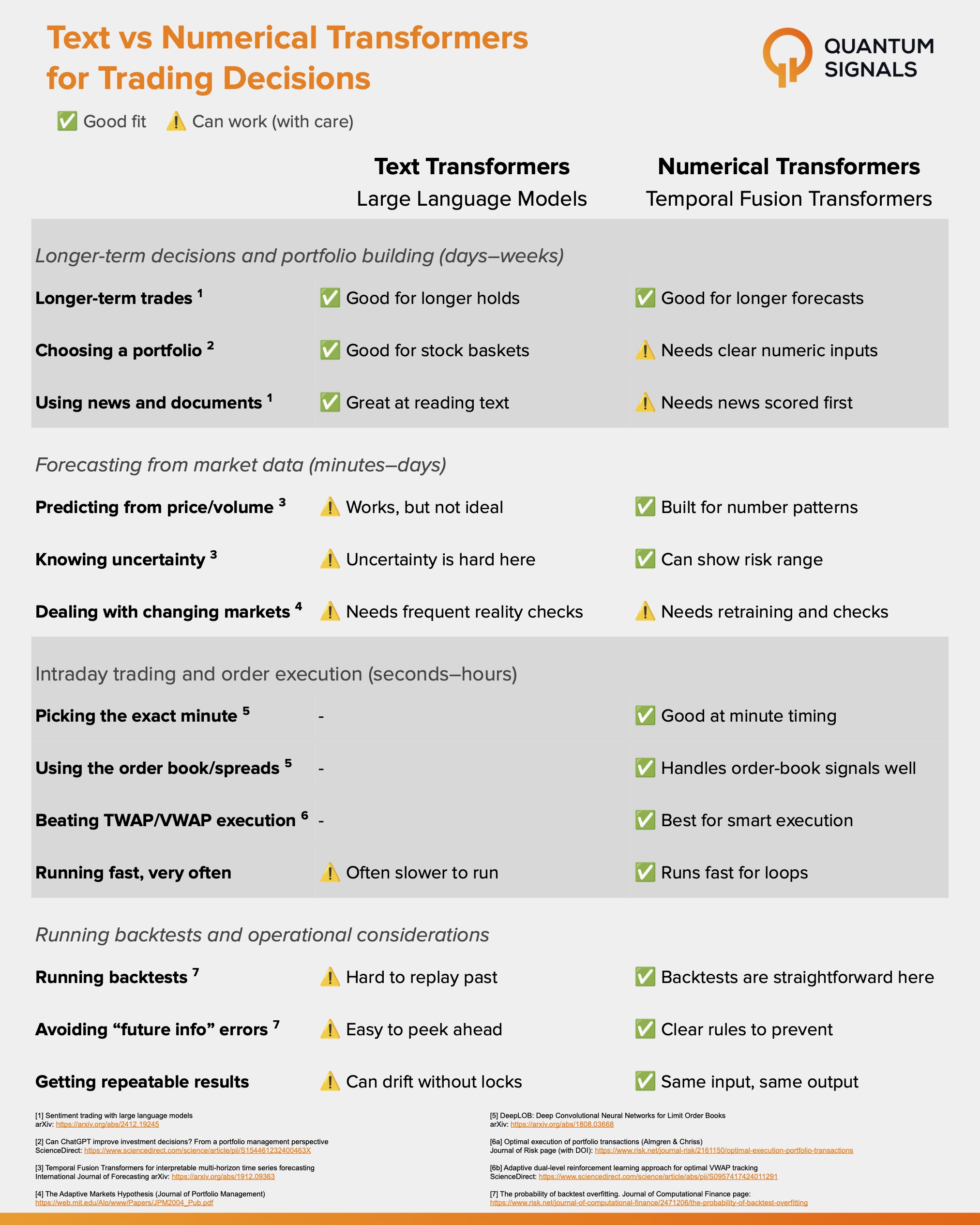
Longer-term decisions and portfolio building (days–weeks)
If the reason you’re trading is written down somewhere (headline, filing, transcript, macro narrative), LLMs are in their element. They’re good at reading messy text, turning it into a clear summary, and helping you decide what belongs in the portfolio. That’s why the strongest “LLM for trading” use cases usually start with language: what happened, why it matters, and which assets it touches.
Forecasting from market data (minutes–days)
When the task is to predict what might happen next from structured market data—prices, volume, technical features, cross-asset inputs—numerical transformer models are built for it. They naturally consume numeric time series and can produce consistent multi-horizon forecasts. LLMs can be pushed into this job, but it’s usually harder to validate and harder to measure uncertainty cleanly.
Intraday trading and order execution (seconds–hours)
Intraday decisions depend on the market’s “plumbing”: spreads, order flow, and the order book. That’s why specialized models exist for order book data, and why execution is often treated as an optimization/control problem. If your goal is better entries/exits inside the day or beating benchmarks like VWAP/TWAP, a dedicated numerical approach is the safer, more standard path.
Running backtests and comparing to history (months–years)
This is where LLM-based trading ideas can accidentally fool you. A backtest asks: “What would the system have done back then?” With LLMs, that’s tricky because the model can change over time, prompts evolve, and it’s easy for newer information to creep into an old decision—creating look-ahead bias. Numeric pipelines have well-known ways to prevent this, but LLM pipelines need extra discipline to be equally fair.
Conclusion
LLMs are best for:
- Longer-term, text-driven decisions (days/weeks)
- Portfolio composition / screening from messy info
- Turning news into usable signals (then handing off to a numeric model)
TFT-style numerical transformers are best for:
- Numeric time-series signals (especially intraday/tactical)
- Microstructure-aware modeling (order book / spreads / flow)